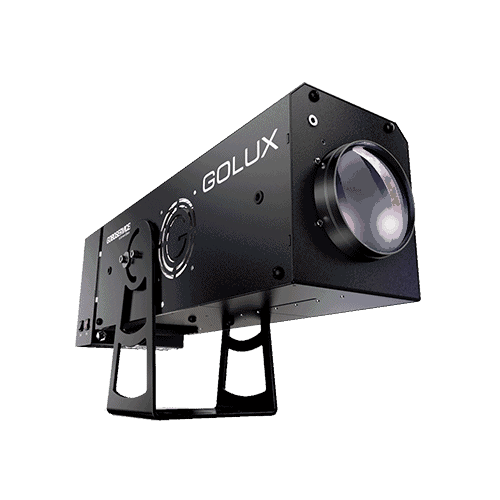
The ideal condition for projecting images occurs when the projection surface is perpendicular to the light beam, even if this condition cannot always be obtained for various reasons. Actually, tilting the projector affects the size of the projected image, so the greater the tilt angle, the greater the unwanted effect.
From the optics we know that an inclined projection causes a deformation of the projected image called “keystone effect”: it is nothing more than the trapezoidal distortion of the projected image.
To avoid this effect, the image must be distorted even before it is projected.
For this reason, when ordering a gobo that must be projected on an inclined surface, it is advisable to provide us with some information:
- the distance PK (between projector and projection surface);
- the distance KC
- the focal distance
- the direction of the projection (from bottom to top or vice versa, or left to right or vice versa).
Based on these indications, Goboservice is able to accurately calculate the deformation a gobo needs so that the projected image does not appear distorted. This is valid for both horizontal and vertical distortions.